Wednesday, August 24, 2005

"Diagnose me properly and I'll sue your ass!"

I am overweight. I know that. I know that it can negatively impact my health. I am a grownup. When I visit professionals, be they car mechanics, lawyers, tarot card readers, or physicians, I expect the unvarnished truth as best as they can observe and relate it. That's what I pay them for.

Apparently, not all grownups desire candor from their health care professional. They prefer the truth to be skirted. Furthermore, if a candid comment should slip from said physician's mouth such as:

"I told a fat woman she was obese," Bennett says. "I tried to get her attention. I told her, 'You need to get on a program, join a group of like-minded people and peel off the weight that is going to kill you.' "

it is deemed worthy, in at least in this one case, of a lawsuit. Which is fine, because we have a right to be silly and I lean to supporting the right to file a "frivolous lawsuit" because it can generally be kicked in a nanosecond.

The woman in question had several options other than the lawsuit. She could have:
(a) Told her doctor that he was a dumbass, exercising her inner child without detriment to anyone since the doctor would have blown off the comment.
(b) Contested the diagnosis or simply have walked out, never to return again, exercising her inner adult which maintains the right to disagree without detriment to others.

But the lawsuit is NOT the insane part. The insane part is the idiotic state board which has disciplinary authority over Dr. Bennett, which is planning to, well, discipline him. So, now the patient is not only possibly endangering her own health, she's quite possibly on the road, again with the State Board's complicity, to endangering other people's health.

This is scary. We are muzzling the truth because the truth hurts, is emotionally painful to deal with.

"Physicians have to be professional with patients and remember everyone is an individual. You should not be inflammatory or degrading to anyone," said board member Kevin Costin.

I'm surprised that Mr. Costin didn't go on to list other potential transgressions:

"Hey, if that cancer's left untreated, you're probably not gonna see Christmas."
"If you persist in not eating any vitamin C, you're gonna get scurvy."
"Smoking three packs a day, and swilling half a quart a vodka might increase your baby's chances of suffering some sort of birth defect."


Apparently, the Hippocratic Oath's first line has now been changed, "In any event, do not offend."

We are a nation of spoiled children in so many respects.

Should Dr. Bennett ever have occasion to see Mr. Costin bleeding from the femoral artery, I hope he has the decency to not embarass him in front of morbid onlookers by applying a tourniquet. He should just walk on by, mentioning that the blood looks quite healthy and full of hemoglobin.

Tuesday, August 23, 2005

Another Cindy Sheehan Analogy

Chap has taken issue with my analogies (below), inspired by his post and Edmund Morris's recent column describing Cindy Sheehan as an "emotional predator." He prefers the comparisons offered by Carl Stephenson's 1938 short story, Leiningen versus the Ants.

Leiningen is the decidedly Anglo-Saxon master of a sizable Brazilian plantation who is warned that he, his Indian laborers, and his plantation are about to meet a certain and horrible doom at the hands of a twenty-square mile regiment of army ants. Leiningen refuses to yield his calm to panic and his plantation to the "elementals" and sets out to win the impending battle with the insects through his superior intellect and fortifications, including a moat and a ring of fire. Leiningen further relies on his calm deportment to lead his emotional "peons" to victory.

Leiningen and his workers fight the army ants valiantly and creatively. They hurl their efforts into keeping the moat current swift to prevent the equally wily ants from crossing in mini-rafts made from tamarind leaves. They use petrol sprinklers to soak and drown the ants in oil as well as using the oil to create a fire wall. But the ants keep on coming. In one last brave attempt, Leiningen dons knee-high boats, gators, and other protective clothing soaked in oil and an ant-repelling salve in order to make a dash for a dam valve, which, if turned by the heroic Leiningen, will flood the plantation, kill the entire company of ants, and save the remaining workers, as well as saving himself. As he makes his way to and from the valve release, the ants tear into his flesh, "etching acid into his eye", and other nastiness, but Leiningen succeeds in his rescue mission and just makes it back to the plantation house, bones exposed from the carnivorous ant attack. Bloodied, as it were, but unbowed by "acts of God" and the "elementals" offered by the jungle.

I guess we are to take from this fascinating analogy, that Cindy Sheehan is the lead army ant in this story, with other lieutenant ants (say Michael Moore) providing discipline in the ranks and George W. Bush is Leiningen at the plantation in Crawford, with the "Mainstream Media" playing the role of the alarmist Brazilian District commissioner. I find all this weird but entirely illuminating. Illuminating, because I believe that so many of W's supporters do in fact, view him as a protector of the plantation and Cindy Sheehan as an opportunistic carnivore who has legions of nasty co-conspirators, and the MSM as enabling said carnivores and/or providing unnecessarily alarmist and negative portrayals of the situation in Iraq. Some passages from the story are in order:


"The Brazilian official threw up lean and lanky arms and clawed the air with wildly distended fingers. "Leiningen!" he shouted. "You're insane! They're not creatures you can fight--they're an elemental--an 'act of God!' Ten miles long, two miles wide--ants, nothing but ants! And every single one of them a fiend from hell; before you can spit three times they'll eat a full-grown buffalo to the bones. I tell you if you don't clear out at once there'll he nothing left of you but a skeleton picked as clean as your own plantation."

"Leiningen grinned. "Act of God, my eye! Anyway, I'm not an old woman; I'rn not going to run for it just because an elemental's on the way. And don't think I'm the kind of fathead who tries to fend off lightning with his fists either. I use my intelligence, old man. With me, the brain isn't a second blindgut; I know what it's there for. When I began this model farm and plantation three years ago, I took into account all that could conceivably happen to it. And now I'm ready for anything and everything--including your ants."

{...}

" Moreover, during his three years as a planter, Leiningen had met and defeated drought, Hood, plague and all other "acts of God" which had come against him-unlike his fellow-settlers in the district, who had made little or no resistance. This unbroken success he attributed solely to the observance of his lifelong motto: The human brain needs only to become fully aware of its powers to conquer even the elements. Dullards reeled senselessly and aimlessly into the abyss; cranks, however brilliant, lost their heads when circumstances suddenly altered or accelerated and ran into stone walls, sluggards drifted with the current until they were caught in whirlpools and dragged under. But such disasters, Leiningen contended, merely strengthened his argument that intelligence, directed aright, invariably makes man the master of his fate.

Yes, Leiningen had always known how to grapple with life. Even here, in this Brazilian wilderness, his brain had triumphed over every difliculty and danger it had so far encountered. First he had vanquished primal forces by cunning and organization, then he had enlisted the resources of modern science to increase miraculously the yield of his plantation. And now he was sure he would prove more than a match for the "irresistible" ants."

{...}

"Leiningen mounted his horse, which at the feel of its master seemed to forget its uneasiness, and rode leisurely in the direction of the threatening offensive. The southern stretch of ditch--the upper side of the quadrilateral--was nearly three miles long; from its center one could survey the entire countryside. This was destined to be the scene of the outbreak of war between Leiningen's brain and twenty square miles of life-destroying ants."

{...}

"Hadn't this brain for once taken on more than it could manage? If the blighters decided to rush the ditch, fill it to the brim with their corpses, there'd still be more than enough to destroy every trace of that cranium of his. The planter's chin jutted; they hadn't got him yet, and he'd see to it they never would. While he could think at all, he'd flout both death and the devil."

Even as it was, it could hardly be described as rosy, though the planter seemed quite unaware that death in a gruesome form was drawing closer and closer. As the war between his brain and the "act of God'' reached its climax, the very shadow of annihilation began to pale to Leiningen, who now felt like a champion in a new Olympic game, a gigantic and thrilling contest, from which he was determined to emerge victor. Such, indeed, was his aura of confidence that the Indians forgot their stupefied fear of the peril only a yard or two away; under the planter's supervision, they began fervidly digging up to the edge of the bank and throwing clods of earth and spadefuls of sand into the midst of the hostile fleet."

{...}

"No, there was only one thing for it, he'd have to make the attempt himself; he might just as well be running as sitting still, anyway, when the ants finally got him. Besides, there was a bit of a chance. Perhaps the ants weren't so almighty, after all; perhaps he had allowed the mass suggestion of that evil black throng to hypnotize him, just as a snake fascinates and overpowers. The ants were building their bridges. Leiningen got up on a chair. "Hey, lads, listen to me!" he cried. Slowly and listlessly, from all sides of the trench, the men began to shuffle towards him, the apathy of death already stamped on their faces.

"Listen, lads!" he shouted. "You're frightened of those beggars, but you're a damn sight more frightened of me, and I'm proud of you. There's still a chance to save our lives--by flooding the plantation from the river. Now one of you might manage to get as far as the weir--but he'd never come back. Well, I'm not going to let you try it; if I did I'd be worse than one of those ants. No, I called the tune, and now I'm going to pay the piper."

{...}

"Leiningen lay on his bed, his body swathed from head to foot in bandages. With fomentations and salves, they had managed to stop the bleeding, and had dressed his many wounds. Now they thronged around him, one question in every face. Would he recover? "He won't die," said the old man who had bandaged him, "if he doesn't want to.''
The planter opened his eyes. "Everything in order?'' he asked.
"They're gone,'' said his nurse. "To hell." He held out to his master a gourd full of a powerful sleeping draught. Leiningen gulped it down.
"I told you I'd come back," he murmured, "even if I am a bit streamlined." He grinned and shut his eyes. He slept."


As far a W being the latter day Leiningen, I don't think it works. I don't think he's experienced a scintilla of self-doubt and he certainly has never played the role of a latter-day George Washington, who put not only his fortune, but put his life on the line for his country. I don't think you have to put either on the line to demonstrate your patriotism but you do have to put them on the line if you want the legitimate respect due Washington and the fictional Leiningen.

And Cindy Sheehan as an army ant who wants to metaphorical destroy the Bush fortune and tear into his flesh....? No sale. She was one of many grieving mothers of the fallen, who several months ago started to make her views on the war known in a loud way. She originally received very little attention -- the Nation magazine put her face on their March 28th issue, four months before there was an inkling of Camp Cindy. But then the zeitgeist changed. There were the 27 fallen servicemen in the first three days of this month. And the President wasn't offering any reason not to expect 27 casulties in the first three days of next August and the August after that. And he wasn't offering an explanation as to why the present and future sacrifice was needed. How did offering young men to Mars, the God of War protect their families and fellow citizens. Was Iraq truly flypaper for Al Qaida? How so? When will our soldiers come home -- you said this war would be short -- you declared "major combat operations" were completed over two years ago?

Those questions, the changed zeitgeist, an anti-war movement with no spokesman, an opposition party with no leader possessing a spine, and a press corps with no missing white woman nor sex scandal to cover, all congealed around the person of Cindy Sheehan -- the personification of the Reagan Democrat/Irish Catholic if ever there was one. The mother of an altar boy, Eagle Scout, a soldier who re-enlisted -- a mother whose son demonstrated the bravery of Leiningen.

Where did that bravery come from?
Did any of that bravery, that courage, come from his mother? The easy thing for Cindy Sheehan to have done, would be proclaiming unflagging support for the President and his policies. She wouldn't be the object of ridicule, she wouldn't be in Crawford, in a ditch, having to deal with the likes of David Duke on one hand and Michelle Malkin on the other. She wouldn't have her personal life splashed on Drudge and cable news. But she believes in the righteousness of her cause every bit as her son did the cause he died for and she shows the same tenacity he apparently demonstrated his whole life. And so she stayed in the ditch until her mother's stroke and shows every sign of returning to the ditch or the White House. The tree lies not far from the apple.

Cindy Sheehan seeks not to tear the flesh from the President, nor destroy his fortune. She seeks answers, explanations, and promises of an exit strategy. That is the request of 60% of the electorate, some of whom, tangentially, may wish to tear the flesh from W's bones and see his financial and political fortunes come to ruin. But the dominant point of overlap, the critical mass, is asking, "When can the soldiers come home?"

And the supposed Leiningen, President Bush's response: "I need to get on with my life", and the cryptic, "When Iraqis stand up, America will stand down." Now, Leiningen did sleep soundly in between rounds with the ants, but he was back at the ants the next morning. He rallied his workers with his calm demeanor, forceful exhortations, and promises of higher wages (rather than privatizing their pensions). But most importantly, he rallied them with his plan, his vision.

He had a plan for dealing with the ants. And the plan was transparent, detailed, and logical. And there was a fallback plan. And, Leiningen's ingenuity was so obvious, so present, that if those plans were circumnavigated by the ants, the workers knew that he would come up with a third one (which he did). Leiningen never said things were going well when they weren't. He didn't announce to his workers on the evening after the first round, "Mission Accomplished."


This was the first I had read the Leiningen story. It was adapted into a radio play and in 1954 it was made into the Charlton Heston movie The Naked Jungle which I recall watching (quite terrified of the ants) on a Sunday afternoon as a child. The plot summary:

"Joanna Selby travels deep inside the South American jungle to meet for the first time Carl Leiningen, a man she has married by mail order and the owner of a vast plantation that covers 200,000 acres. But once there she is shocked at the savagery of life among the Indians that work on the plantation. And then Leiningen rejects her when he finds that she has been married before, not wanting to take "another man's pickings." But they are forced together in the face of an army of marabunta ants that enters the estate, devouring everything in their path."

I did a little more Googling and found this surprise -- apparently the former chairman of the Pentagon's
Defense Policy Board Advisory Committee, Richard Perle, is working on a remake of The Naked Jungle, tentatively titled The Naked Jungle II: Leiningen versus Gold Star Mothers & Fat Leftists. The buzz on the internets is that Perle has approached filmmaker Mel Gibson to both produce and direct this movie. Details are still sketchy but one cult site provided me with this plot summary as well as the poster Perle used in the pitch meeting with Gibson:

"Ahmed Chalabi travels deep inside the Washington bureaucracy to meet for the first time, George W. Leiningen, a man he would like to marry but whom the local customs forbid to do so. He convinces Leiningen to invade his homeland to displace the ruling thug. But he is disappointed that he doesn't immediately get to take the thug's place as Leiningen had originally assured him. Heart-broken, he cultivates al-Sadr, the Shia clergyman whose militia the US Army was trying to destroy in an ironic plot twist. Meanwhile, back at the ranch, Leiningen is confronted by scores of protesting ants who are in legion with a crazed driver ant named Cindy who has a fat ant friend named Michael. All these ants are unable to do any real harm to Leiningen's person, but he is determined to demonstrate his courage by going to Idaho."

Thursday, August 18, 2005

Most Emailed


Checking out today's (August 18th) list of "most emailed" articles from the New York Times, one finds that the top three articles all have to do with the war and all are critical of it from different vantage points. Recommend them all.

1. Maureen Dowd: Biking Toward Nowhere
2.Bob Herbert: Blood Runs Red, Not Blue
3.Op-Ed Contributor: Left Behind
4. Many Going to College Are Not Ready, Report Says
5. Being a Patient: In the Hospital, a Degrading Shift From Person to Patient

Wednesday, August 17, 2005

Cindy Sheehan: "Emotional Predator"

Cindy Sheehan's Neural Neutralizer

{Alas, the trip is done. Still have many more pics and more travelogue -- will catch that up eventually, but the moment is begging to be philosophized. In one sense, nothing's changed - back to dueling with Mr. Chap over at Chapomatic. We've got one pissing contest going over whether the US is weaker and Iran stronger in the Middle East (my position, duh) and another one going on over Cindy Sheehan (huge surprise). This is slightly adapted from a comment I made earlier today at Chap's. You may want to read Reagan biographer Edmund Morris's column first, but do it on an empty stomach.)

Morris writes: “A president has to protect himself from emotional predators, or he’d be sucked dry within a week of taking office.”

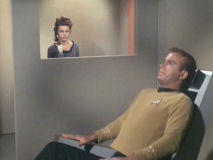
Thanks to Edmund Morris’s counseling, it’s all clear now. Cindy Sheehan was the former assistant to Dr. Adams on Tantalus Five, home to the Tantalus Penal Colony, which viciously used the neural neutralizer on its inmates, destroying their minds in the process. “Dammit, Jim, if we let the President talk to her, he’ll having nothing left for his bike ride with Lance Armstrong; we don't dare leave him alone with her!”

Cindy Sheehan warming up her neural neutralizer technique on Capt. James T. Kirk before moving on to President Bush.

Or maybe she’s one of those space vampires depicted in LifeForce, who sought victims to drain of, well, their “lifeforce.”

Or maybe she’s a Skeksis from Dark Crystal who wants to drain the essence from the G. (Gelfling) W. Bush.

Skeksis Cindy Sheehan

G. (Gelfling) W. Bush

If Morris has W pegged as someone who is truly at high risk from consorting with the likes of Cindy Sheehan, then the wimp factor rears its ugly head.

While we’re on the sucking metaphor, I’m reminded of Lincoln’s wry observation when inundated by thousands of office seekers: “There’s too many pigs for the teats.” This from a President who faced a far more dire situation than the current occupant, who, nevertheless, found time to speak to the applicants as well as dealing with a wife and cabinet who were far more emotionally predatory than W’s complement.

It’s noteworthy that Morris was easily able to catalog the connection with emotion and the average American of past Presidents but did not cite a single example of the current President doing the same. I do remember one, W’s speech at the National Cathedral in the wake of 9/11. For me, it was his finest moment as President. I don’t think Bush is unable to emote or connect -- it’s that he chooses not to. It’s especially the case that he chooses not to connect with the emotion or the person who challenges his view of the world. He keeps all such persons at a distance, and when they intrude on either his physical or psychological space, they are physically and metaphysically dismissed. Classic dry drunk behavior -- the list includes:

  • Pomposity

  • Exaggerated self-importance

  • A rigidly judgmental outlook

  • Impatience

  • Childish behavior

  • Irresponsible behavior

  • Irrational rationalization

  • Projection

  • Overreaction

Bush's psychological space is so fragile, his grip on reality so tenuous, that potential challenges cannot be countenanced.

It’s no secret that W has earned the nickname Bubble Boy. He has prided himself on his isolation from American opinion – he doesn’t read newspapers. As his campaign rallies and Social Security "Town Hall Meetings" attest, he can only attend events where the guests are carefully vetted, and prefers to appear in front of crowds of soldiers, sailors, airmen, and Marines whose fealty (at least on camera) is automatic. He hasn’t attended one single military funeral. And the one time he did meet with Cindy Sheehan, he said, upon entering the room with his usual aplomb and decorum, “So who are we honoring here?”

The President hasn’t only protected himself from “emotional predators”, he’s protected himself from ANYTHING that challenges in the remotest sense, his view of reality, a view which is a wholesale construct of an inner dialogue between his Id and his Ego, whom he calls “God.”

Pitiful.

Sunday, July 17, 2005

Hiatus & Adventure


There will be little or no posting here at Mtn. Philosopher until Aug 13th. Genna and I are taking a 25 day road trip out west and to DC. You can follow our adventures here - http://deadwoodtodc.blogspot.com We hope to post every other day or so.

Monday, July 11, 2005

Better Than Viagra


Full Text at ThinkProgress


QUESTION: Scott, can I ask you this: Did Karl Rove commit a crime?

MCCLELLAN: Again, David, this is a question relating to a ongoing investigation, and you have my response related to the investigation. And I don't think you should read anything into it other than: We're going to continue not to comment on it while it's ongoing.
Advertisement

QUESTION: Do you stand by your statement from the fall of 2003, when you were asked specifically about Karl and Elliot Abrams and Scooter Libby, and you said, "I've gone to each of those gentlemen, and they have told me they are not involved in this"?

QUESTION: Do you stand by that statement?

MCCLELLAN: And if you will recall, I said that, as part of helping the investigators move forward on the investigation, we're not going to get into commenting on it. That was something I stated back near that time as well.

QUESTION: Scott, this is ridiculous. The notion that you're going to stand before us, after having commented with that level of detail, and tell people watching this that somehow you've decided not to talk. You've got a public record out there. Do you stand by your remarks from that podium or not?

MCCLELLAN: I'm well aware, like you, of what was previously said. And I will be glad to talk about it at the appropriate time. The appropriate time is when the investigation...

QUESTION: (inaudible) when it's appropriate and when it's inappropriate?
MCCLELLAN: If you'll let me finish.

QUESTION: No, you're not finishing. You're not saying anything.
You stood at that podium and said that Karl Rove was not involved. And now we find out that he spoke about Joseph Wilson's wife. So don't you owe the American public a fuller explanation. Was he involved or was he not? Because contrary to what you told the American people, he did indeed talk about his wife, didn't he?


MCCLELLAN: There will be a time to talk about this, but now is not the time to talk about it.

QUESTION: Do you think people will accept that, what you're saying today?

MCCLELLAN: Again, I've responded to the question.

QUESTION: You're in a bad spot here, Scott...
(LAUGHTER)
... because after the investigation began -- after the criminal investigation was under way -- you said, October 10th, 2003, "I spoke with those individuals, Rove, Abrams and Libby. As I pointed out, those individuals assured me they were not involved in this," from that podium. That's after the criminal investigation began.
Now that Rove has essentially been caught red-handed peddling this information, all of a sudden you have respect for the sanctity of the criminal investigation.

MCCLELLAN: No, that's not a correct characterization. And I think you are well aware of that.
We know each other very well. And it was after that period that the investigators had requested that we not get into commenting on an ongoing criminal investigation.
And we want to be helpful so that they can get to the bottom of this. Because no one wants to get to the bottom of it more than the president of the United States.
I am well aware of what was said previously. I remember well what was said previously. And at some point I look forward to talking about it. But until the investigation is complete, I'm just not going to do that.

QUESTION: So you're now saying that after you cleared Rove and the others from that podium, then the prosecutors asked you not to speak anymore and since then you haven't.

MCCLELLAN: Again, you're continuing to ask questions relating to an ongoing criminal investigation and I'm just not going to respond to them. QUESTION: When did they ask you to stop commenting on it, Scott? Can you pin down a date?

MCCLELLAN: Back in that time period.

QUESTION: Well, then the president commented on it nine months later. So was he not following the White House plan?

MCCLELLAN: I appreciate your questions. You can keep asking them, but you have my response.

QUESTION: Well, we are going to keep asking them.

When did the president learn that Karl Rove had had a conversation with a news reporter about the involvement of Joseph Wilson's wife in the decision to send him to Africa?

MCCLELLAN: I've responded to the questions.

QUESTION: When did the president learn that Karl Rove had been...

MCCLELLAN: I've responded to your questions.

QUESTION: After the investigation is completed, will you then be consistent with your word and the president's word that anybody who was involved will be let go?

MCCLELLAN: Again, after the investigation is complete, I will be glad to talk about it at that point.

QUESTION: Can you walk us through why, given the fact that Rove's lawyer has spoken publicly about this, it is inconsistent with the investigation, that it compromises the investigation to talk about the involvement of Karl Rove, the deputy chief of staff, here?

MCCLELLAN: Well, those overseeing the investigation expressed a preference to us that we not get into commenting on the investigation while it's ongoing. And that was what they requested of the White House. And so I think in order to be helpful to that investigation, we are following their direction.

QUESTION: Scott, there's a difference between commenting on an investigation and taking an action...

MCCLELLAN: (inaudible)

Thursday, July 07, 2005

1,000 Maimed & Dead People "Working to Our Advantage"

Plagiarized from Media Matters
-----------------------------------
The following exchange between Fox News host Brian Kilmeade and Fox News business contributor and substitute host Stuart Varney occurred during breaking news coverage of the attacks on London subways and buses on the July 7 edition of Fox News' Fox & Friends:

KILMEADE: And he [British Prime Minister Tony Blair] made the statement, clearly shaken, but clearly determined. This is his second address in the last hour. First to the people of London, and now at the G8 summit, where their topic Number 1 --believe it or not-- was global warming, the second was African aid. And that was the first time since 9-11 when they should know, and they do know now, that terrorism should be Number 1. But it's important for them all to be together. I think that works to our advantage, in the Western world's advantage, for people to experience something like this together, just 500 miles from where the attacks have happened.
VARNEY: It puts the Number 1 issue right back on the front burner right at the point where all these world leaders are meeting. It takes global warming off the front burner. It takes African aid off the front burner. It sticks terrorism and the fight on the war on terror, right up front all over again.
KILMEADE: Yeah.
----------------------------
What sick, confused people.

A Democratic Republic or a Big Fat Lie

Fellow philosopher. Dennis, who blogs at Spanky's Speculations, writes a nice response to the position in the comments section, which held that the U.S. is a "supposed to be a representive republic, not a democracy." Dennis says:

"A democracy is a form of government in which the public wields the biggest share of political authority, and exercises it either directly or through representatives. We are a republic (a form of government in which representatives lead on behalf of the people) and we are also a democracy. Whenever someone says we are a republic but not a democracy, I cringe, because it means they've missed something crucial to the American way of life. We are, and have always been, a democratic republic, just as the founding fathers intended.

The last sentence in the Gettysburg Address is this: "It is rather for us to be here dedicated to the great task remaining before us -- that from these honored dead we take increased devotion to that cause for which they gave the last full measure of devotion -- that we here highly resolve that these dead shall not have died in vain -- that this nation, under God, shall have a new birth of freedom -- and that government of the people, by the people, for the people, shall not perish from the earth."

It is from the "democratic" part of the equation that we have that concept--a government of, by and for the people. A republic that isn't democratic need only be a government for the people. The Union of Soviet Socialist Republics demonstrated that the concept of individual freedom isn't crucial to a republican form of government, either. Yes, Virginia, we are a republic, but that can never, ever be all that we are. We're a democratic republic, or we're a big, fat lie."

Tuesday, July 05, 2005

"Not Like the Brazen Giant of Greek Fame..."

From the pedestal of the Statue of Liberty

The ever-eloquent Billmon captures my feelings with this powerful essay. Definitely worth reading the whole thing. Here's your snip:

I'm not a big fan of patriotism, at least not as most Americans understand the word. Patriotism is just another word for nationalism, and nationalism in my book is the modern equivalent of the black plague -- an incubator of xenophobia at its least, a killer of millions at its absolute worst. And we've seen enough of the absolute worst over the past century to understand where nationalism could ultimately lead: the extinction of the entire human race.

Still, there are emotional attachments to home -- to the familiar, the dear, the remembered -- that go deeper than the intellect and pull harder than reason. Tribal loyalty is a powerful thing. On the morning of 9/11, I was as much a patriot as any man or woman alive, and would have greedily torn Bin Ladin to pieces with my own hands to avenge "our" dead.

But hatred and revenge are patriotism's curse, not its justification. When Lincoln spoke of "mystic cords of memory" and urged his countrymen to put their common heritage ahead of their political divisions, he wasn't appealing to their tribal loyalties, but their loyalty to an ideal: democratic government under the law. If American patriotism has any claim to be an exception to the general run of blind national chauvinism, it has to be found in that idea. If America is to be an exceptional nation, one worth glorifying above all others, it has to be because of the quality of her justice and the strength of her democracy -- not because of the language she speaks, or the God she worships or the color of her skin. And not because of her material wealth or military power or imperial ambitions. Least of all those.

Pat Buchanan and I agree on very few things, but he wrote something many years ago that I can endorse wholeheartedly: "America was a great country before she was a rich country." In many ways a greater country, I would probably add -- not because she was poor (if you've seen real poverty, Third World poverty, you know there's nothing to admire about it) but because she stood a little less apart from the rest of humanity, and had to rely a little more heavily on the promises inscribed on the Statue of Liberty, rather than power of her aircraft carriers, to impress the world.

What I saw in Jimmy John's hot dog stand was the ghost of an America I used to know -- a land of little guys looking for a place to build something. Of strong unions and good-paying jobs that didn't require a PhD. Of black and white televisions where you could watch the cheesiest ads imaginable. Of corner drug stores and transistor radios and long evenings spent sitting on the front porch, talking to the neighbors.

Monday, July 04, 2005

Another sign that communism is dead in China...

from Slate
"State media has also highlighted cases of obsessed Internet gamers, some of whom have flunked out of school, committed suicide or murder. Nonetheless, Internet cafes continue to thrive, with outlets found in even the smallest and poorest of villages. Most are usually packed late into the night.

Dr. Kimberly Young, a Bradford, Pa., clinical psychologist whose 1998 book on Internet addiction has been translated into Chinese, says she's not surprised the Chinese would face problems with Internet overuse.

"They are catching up with a lot of our technology, and certainly at that juncture, are now able to run into some of the same difficulties," Young said."

Mistakes re-visited, a Hawk's Perspective

Tony Cordesman, Reality-Based Hawk
Center for Strategic and International Studies scholar and analyst, Tony Cordesman, recently completed a paper, Iraq's Evolving Insurgency, which is essentially a first few chapters/rough draft for a book to be published this fall. The mistakes he chronicles are quite similar to the ones that those of us who opposed the war cite.
His verdict first, followed by the evidence:

"It is perfectly true that foresight is far harder than "20-20 hindsight." Many, if not most, of these problems were, however, brought to the attention of the President, National Security Council, State Department, Department of Defense, and intelligence community in the summer and fall of 2002, and in Interagency forums. No one accurately prophesized all of the future, but many inside and outside government warned what it might be. The problem was not that the system did not work in providing many key elements of an accurate assessment, it was that the most senior political and military decision makers ignored what they felt was negative advice out of a combination of sincere belief, ideological conviction, and political and bureaucratic convenience."

{ed note: This is what happens when you run a war like you ran Arbusto and Harken and there's no Harvard endowment fund to bail you out. Or, more to the point, it's running the war in the same cynical, insular, unilateral, "fuck-you", Mayberry-Machivellian, fashion in which the Bushies do EVERYTHING!}

• A failure to accurately assess the nature of Iraqi nationalism, the true level of culture differences, and the scale of Iraq problems. This failure of strategic assessment included the failure to see the scale of Iraq’s ethnic and sectarian differences, its economic weaknesses and problems, the difficulty of modernizing an infrastructure sized more to 16-17 million than the current population of 25-26 million, unrealistic estimates of "oil wealth," the probable hardcore support for the former regime in Sunni areas, secular versus theocratic tensions, the impact of tribalism, the impact of demographics in a society so young and with so many employment problems, and a host of other real-world problems that became US and Coalition problems the moment Coalition forces crossed the border.

• The failure to plan and execute effective broader information operations before, during and after the invasion to win the "hearts and minds of Iraqis," persuade them that the Coalition came a liberators that would leave rather than occupiers who would stay and exploit Iraq, and that the Coalition would provide aid and support to an truly independent government and state. A secondary failure to anticipate and defuse the flood of conspiracy theories certain to follow Coalition military action.

• The failure to plan and execute efforts to maintain the process of governance at the local, provincial, and central level; to anticipate the risk the structure of government would collapse and the risk of looting, and to create a plan for restructuring the
military, police, and security forces -- all of which needed to be proclaimed and publicized before, during, and immediately after the initial invasion to win the support of Iraqi officials and officers who were not linked to active support of Saddam Hussein and past abuses, and to preserving the core of governance that could lead to the rapid creation of both a legitimate government and security.

• Broad failures by what a leading officer involved in planning operations in Iraq by "quiescent US military and Intelligence community leaders who observed the distortion/cherry picking of data that lead to erroneous conclusions and poor planning," but failed to press their case or force the issue.

• Over-reliance on exile groups with limited credibility and influence in Iraq.

• Miscalculations about UN support, NATO & coalitions, and transit through Turkey.

• Failing to the provided the personnel and skills necessary to secure Iraqi rear areas and urban areas as the Coalition advanced, and to prevent the massive looting of
government offices and facilities, military bases, and arms depots as the during and after the fighting: A process that effectively destroyed the existing structure of governance and security without making any initial effort to replace it.

• The creation of a small cadre of civilians and military in the Office of Reconstruction and Assistance, many initially recruited for only three month tours, that was charged with a largely perfunctory nation building task, given negligible human and financial resources, not allowed meaningful liaison with regional powers, and not integrated with the military command.

• Replacing ORHA after the fall of Saddam Hussein with the Coalition Provisional Authority (CPA), and then suddenly improvising a vast nation building and stability effort, recruiting and funding such an operation with little time for planning, and then attempting to carry out the resulting mission along heavily ideological lines that attempt to impose American methods and values on Iraq.

• Placing the CPA and US commands in separate areas, creating large, secure zones that isolated the US effort from Iraqis, and carrying out only limited coordination with other Coalition allies.

• Staffing the CPA largely with people recruited for short tours, and often chosen on the basis of political and ideological vetting, rather than experience and competence.

• A failure not only to anticipate the threat of insurgency and outside extremist infiltration, in spite of significant intelligence warning, but to deploy elements of US forces capable of dealing with counterinsurgency, civil-military operations, and nation building as US forces advanced and in the immediate aftermath of the collapse of the regime. Creating regional commands based on administrative convenience, rather than need, and leaving most of the initial tasks of stability operations and nation building up to improvisation by individual local commanders who had minimal or no expert civilian support.

• This failure was compounded by a lack of language and area skills and training on the part of most US military forces, and intelligence capabilities designed to provide the human intelligence (HUMINT), technical collection, analytic capabilities, and "fusion" centers necessary for stability, counterterrorist and counterinsurgency operations.

• Planning for premature US military withdrawals from Iraq before the situation was clear or secure, with major reductions initially planned to begin some three months after the fall of Saddam’s regime, rather than planning, training, and equipping for a sustained period of stability operations.

• Failure to anticipate and prepare for Iraqi expectations after the collapse of Saddam’s regime, and for the fact that many Iraqis would oppose the invasion and see any sustained US and coalition presence as a hostile occupation.

• A failure to react to the wartime collapse of Iraqi military, security, and police forces and focus immediately on creating effective Iraqi forces – a failure that placed a major and avoidable burden on US and other coalition forces and compounded the Iraqi feeling that Iraqi had been occupied by hostile forces.

• A failure to honestly assess the nature and size of the Iraqi insurgency as it grew and became steadily more dangerous.

• The failure to provide, or even have available, anything like the civilian elements in the US government, necessary for nation building and stability operations. These problems were particular serious in the State Department and other civilian agencies, and much of the civilian capability the US did have was not recruited or willing to take risks in the field.

• Then creating an occupation authority that planned for several years of occupation, as if a US-led coalition could improves it own values and judgments about the Iraqi people, politics, economy, and social structure for a period of some three years – rather than expedite the transfer of sovereignty back to Iraq as quickly as possible. The record is mixed, but the CPA only seems to have decided to expedite the transfer of sovereignty in October 2003, after the insurgency had already become serious, and its choice of June 2004 for doing so was largely arbitrary. Even then, it failed to make its plans sufficiently convincing to much of the Iraqi people.

I see the Future...


Mahablog calls it right on the impending SC judicial nomination when she writes:

"Liberals are hoping for a not-activist judge who will rule based on law and the facts of the case. The Right is howling for a way-activist judge who will impose a hard right interpretation to everthing, damn the case and damn the Constitution. And this is happening while the Right is snarling that it's the Left who wants to use the Courts to impose its will."

But I disagree with her prediction here:

"If he nominates anyone who displeases the Right, he's likely to lose much of their support, and right now that's pretty much all he has. If he does nominate a troglodyte the Senate confirmation fight will be fierce and nasty and protracted, and he can't count on the GOP Senators to march in lockstep. He's got to find someone moderate enough to keep the Senate GOP together, but enough of a whackjob to please the Right."

I think W wants a "fierce, nasty, and protracted fight." In fact, I think it might well be the only thing that can save his foundering presidency.

If he goes the "troglodyte" route (as I suggested here), here's all the benefits he gets:
*Immediate tightening of his base. The Dobsians will pull out all stops. They will raise money like crazy, run ads, and turn the culture war artillery rate up to "11".

*The base, which is starting to have a doubt or two at the margins, about the war, shifts its focus to a place where the light is much better on W.

*The media's attention also shifts, away from the war, and to the culture wars. W can't win the culture war either but shifting attention away from the far more consequential conflict is a HUGE win.

*If said troglodyte is filibustered/rejected, then the GOP has another fundraising issue for 2006, as well as an issue that distracts from the war. Additionally, W can then "lower his price" and nominate the moderate, playing to a "healing the nation" narrative that the MSM will be all too happy to indulge, and for which the far right will forgive, since he tried mightily to nominate a Child of Jesus first, only to be temporarily thwarted by the Pharisees, uh, liberal Democrats.

*And, if W were to nominate a moderate from the outset, he can kiss off his base, and the rest of his presidency.
Here comes Jabba!

Just Like Paris Hilton....


...we're expensive and stupid.

From Anne:

Let me get this straight. Capitalists want cheap labor. In order to get cheap labor, you need a population pool who is too stupid to fight for better pay. Except a good capitalist doesn't to spend the extra money it takes to train illiterates.

Then you have politicians who want a stupid population so they will keep voting against their own interests and remain life long indentured servants. Except, because they are stupid and poor, they get sick a lot more often because they don't know how to stay well and can't afford preventative medicine, so they go to the ER more often which raises health care costs for everyone, including capitalists. Plus, now that the indentured servants have now shot their wad on ER visits, they can't afford to buy the crap that capitalists make, so the capitalists lose even more money.

So, when Toyota wants to build a plant on this side of the big water, they choose Canada over America. Why? Because building a plant in America costs a lot more money in health care costs and training. So, we're expensive and stupid.

Just like Paris Hilton...

American Genius

As relevant as ever. Absolute genius.


Hat tip to Tom, John, James, and Ben, with thanks to the signatories who put their lives and fortunes on the line.

The Declaration of Independence of the Thirteen Colonies
In CONGRESS, July 4, 1776

The unanimous Declaration of the thirteen united States of America,

When in the Course of human events, it becomes necessary for one people to dissolve the political bands which have connected them with another, and to assume among the powers of the earth, the separate and equal station to which the Laws of Nature and of Nature's God entitle them, a decent respect to the opinions of mankind requires that they should declare the causes which impel them to the separation.

We hold these truths to be self-evident, that all men are created equal, that they are endowed by their Creator with certain unalienable Rights, that among these are Life, Liberty and the pursuit of Happiness. --That to secure these rights, Governments are instituted among Men, deriving their just powers from the consent of the governed, --That whenever any Form of Government becomes destructive of these ends, it is the Right of the People to alter or to abolish it, and to institute new Government, laying its foundation on such principles and organizing its powers in such form, as to them shall seem most likely to effect their Safety and Happiness.

Prudence, indeed, will dictate that Governments long established should not be changed for light and transient causes; and accordingly all experience hath shewn, that mankind are more disposed to suffer, while evils are sufferable, than to right themselves by abolishing the forms to which they are accustomed. But when a long train of abuses and usurpations, pursuing invariably the same Object evinces a design to reduce them under absolute Despotism, it is their right, it is their duty, to throw off such Government, and to provide new Guards for their future security. —Such has been the patient sufferance of these Colonies; and such is now the necessity which constrains them to alter their former Systems of Government. The history of the present King of Great Britain [George III] is a history of repeated injuries and usurpations, all having in direct object the establishment of an absolute Tyranny over these States. To prove this, let Facts be submitted to a candid world.

He has refused his Assent to Laws, the most wholesome and necessary for the public good.

He has forbidden his Governors to pass Laws of immediate and pressing importance, unless suspended in their operation till his Assent should be obtained; and when so suspended, he has utterly neglected to attend to them.

He has refused to pass other Laws for the accommodation of large districts of people, unless those people would relinquish the right of Representation in the Legislature, a right inestimable to them and formidable to tyrants only.

He has called together legislative bodies at places unusual, uncomfortable, and distant from the depository of their public Records, for the sole purpose of fatiguing them into compliance with his measures.

He has dissolved Representative Houses repeatedly, for opposing with manly firmness his invasions on the rights of the people.

He has refused for a long time, after such dissolutions, to cause others to be elected; whereby the Legislative powers, incapable of Annihilation, have returned to the People at large for their exercise; the State remaining in the mean time exposed to all the dangers of invasion from without, and convulsions within.

He has endeavoured to prevent the population of these States; for that purpose obstructing the Laws for Naturalization of Foreigners; refusing to pass others to encourage their migrations hither, and raising the conditions of new Appropriations of Lands.

He has obstructed the Administration of Justice, by refusing his Assent to Laws for establishing Judiciary powers.

He has made Judges dependent on his Will alone, for the tenure of their offices, and the amount and payment of their salaries.

He has erected a multitude of New Offices, and sent hither swarms of Officers to harass our people, and eat out their substance.

He has kept among us, in times of peace, Standing Armies without the consent of our legislatures.

He has affected to render the Military independent of and superior to the Civil power.

He has combined with others to subject us to a jurisdiction foreign to our constitution and unacknowledged by our laws; giving his Assent to their Acts of pretended Legislation:
For Quartering large bodies of armed troops among us:

For protecting them, by a mock Trial, from punishment for any Murders which they should commit on the Inhabitants of these States:

For cutting off our Trade with all parts of the world:

For imposing Taxes on us without our Consent:

For depriving us, in many cases, of the benefits of Trial by Jury:

For transporting us beyond Seas to be tried for pretended offences:

For abolishing the free System of English Laws in a neighbouring Province, establishing therein an Arbitrary government, and enlarging its Boundaries so as to render it at once an example and fit instrument for introducing the same absolute rule into these Colonies:

For taking away our Charters, abolishing our most valuable Laws, and altering fundamentally the Forms of our Governments:

For suspending our own Legislatures, and declaring themselves invested with power to legislate for us in all cases whatsoever.

He has abdicated Government here, by declaring us out of his Protection and waging War against us.

He has plundered our seas, ravaged our Coasts, burnt our towns, and destroyed the lives of our people.

He is at this time transporting large Armies of foreign Mercenaries to compleat the works of death, desolation and tyranny, already begun with circumstances of Cruelty and perfidy scarcely paralleled in the most barbarous ages, and totally unworthy the Head of a civilized nation.

He has constrained our fellow Citizens taken Captive on the high Seas to bear Arms against their Country, to become the executioners of their friends and Brethren, or to fall themselves by their Hands.

He has excited domestic insurrections amongst us, and has endeavoured to bring on the inhabitants of our frontiers, the merciless Indian Savages, whose known rule of warfare, is an undistinguished destruction of all ages, sexes and conditions.

In every stage of these Oppressions We have Petitioned for Redress in the most humble terms: Our repeated Petitions have been answered only by repeated injury. A Prince whose character is thus marked by every act which may define a Tyrant, is unfit to be the ruler of a free people.
Nor have We been wanting in attentions to our British brethren. We have warned them from time to time of attempts by their legislature to extend an unwarrantable jurisdiction over us. We have reminded them of the circumstances of our emigration and settlement here. We have appealed to their native justice and magnanimity, and we have conjured them by the ties of our common kindred to disavow these usurpations, which, would inevitably interrupt our connections and correspondence. They too have been deaf to the voice of justice and of consanguinity. We must, therefore, acquiesce in the necessity, which denounces our Separation, and hold them, as we hold the rest of mankind, Enemies in War, in Peace Friends.

We, therefore, the Representatives of the united States of America, in General Congress, Assembled, appealing to the Supreme Judge of the world for the rectitude of our intentions, do, in the Name, and by the Authority of the good People of these Colonies, solemnly publish and declare, That these United Colonies are, and of Right ought to be Free and Independent States; that they are Absolved from all Allegiance to the British Crown, and that all political connection between them and the State of Great Britain, is and ought to be totally dissolved; and that as Free and Independent States, they have full Power to levy War, conclude Peace, contract Alliances, establish Commerce, and to do all other Acts and Things which Independent States may of right do. And for the support of this Declaration, with a firm reliance on the protection of divine Providence, we mutually pledge to each other our Lives, our Fortunes and our sacred Honor.

The signers of the Declaration represented the new states as follows:
New Hampshire
Josiah Bartlett, William Whipple, Matthew Thornton

Massachusetts
John Hancock, Samual Adams, John Adams, Robert Treat Paine, Elbridge Gerry

Rhode Island
Stephen Hopkins, William Ellery

Connecticut
Roger Sherman, Samuel Huntington, William Williams, Oliver Wolcott

New York
William Floyd, Philip Livingston, Francis Lewis, Lewis Morris

New Jersey
Richard Stockton, John Witherspoon, Francis Hopkinson, John Hart, Abraham Clark

Pennsylvania
Robert Morris, Benjamin Rush, Benjamin Franklin, John Morton, George Clymer, James Smith, George Taylor, James Wilson, George Ross

Delaware
Caesar Rodney, George Read, Thomas McKean

Maryland
Samuel Chase, William Paca, Thomas Stone, Charles Carroll of Carrollton

Virginia
George Wythe, Richard Henry Lee, Thomas Jefferson, Benjamin Harrison, Thomas Nelson, Jr., Francis Lightfoot Lee, Carter Braxton

North Carolina
William Hooper, Joseph Hewes, John Penn

South Carolina
Edward Rutledge, Thomas Heyward, Jr., Thomas Lynch, Jr., Arthur Middleton

Georgia
Button Gwinnett, Lyman Hall, George Walton

For additional information about the Declaration of Independence, see these sites:
National Archives and Records Administration: Declaration of Independence
Library of Congress: About the Declaration of Independence
Saturday, July 02, 2005

Persuasion, Democratic Party Strategy, and "Wicked Problems"

As usual, Chapomatic has provided food for thought, this time with a mere link.

Brian Leiter, who teaches philosophy and law (Jurisprudence and Evidence), has recently blogged on the wisdom of engaging in persuasion, as opposed to the focusing of one's energies on coherently staking out a position, regardless of its supposed persuasive qualities. He dismisses (correctly) the notion that all positions have two legitmate sides. He does this by delineating the differences between "hard questions" ("What is Foucault's view of the cognitive and epistemic status of the claims of the human sciences?") and "easy questions" ("Are Bush's economic policies in the interests of most people?"). Of this latter category, he writes: "These questions, and many others, are easily addressed in the blogosphere, since there is no serious--or at least no honest or intelligent--dispute about the epistemic merits of the possible answers."

It is precisely this dismissive attitude that Marc Danzinger, a.k.a. Armed Liberal, at Winds of Change takes issue with, essentially characterizing Leiter as an ivory tower elitist:

"And note if you will that it applies to Duncan Black, Tbogg, Yglesias (all too often) and others on the left...it's a variant of "I just can't believe you aren't bowing the ineffable rightness of my positions" that we're used to seeing from the smart fat guy in the isolated cubicle - the one who knows more than anyone else about the fine points of the interactions between the Venice Specific Plan, the California Coastal Act, and Los Angeles planning law, or multi-threaded processing on early x86 chips, or the student films of George Lucas, or prewar Hegelian theory in the works of Lukács."
Danzinger wants Leiter to come out of his tower, uh, "cubicle", and talk to the regular folks and persuade them, even if that means slightly altering his position(s) -- moving to the middle as it were. Leiter sees such talk and political moderation as a fruitless enterprise, that the masses who love Bush live in a place where no rational argument can penetrate. Danzinger responds to this sentiment in his comments section that Leiter's position is essentially a cop out which forgoes the opportunity to advance a progressive ideal or idea:
"The issue is with people - people who may actually have good ideas - who are unwilling to roll up their sleeves and recognize that having the idea is about 10% of the process; getting it diffused and adopted is the balance. And what these people {like Leiter - ed} tend to do is to casually dismiss - out of some style or motive I don't understand - everyone who doesn't immediately start singing in key with them."
I agree entirely with Danzinger on this key point. And if the Democrats want to win, they are going to have to go in this direction. They Democratic Party leadership must find common ground with the working class and its New Deal ideals. In fact, finding that common ground between the self-interests of nation and the self-interests of the working class is the foundation of the New Deal. Any substantive rebirth of the Democratic Party has to occur at this nexus.

Leiter believes that anything other than a hardline position on key issues constitutes unprincipled compromise and he sees universities as citadels of truth that should remain elevated above popular attempts to get the academy to bend to folk wisdom. I can live with that. And to be fair to Leiter, he openly admits that ideas in his blog would make for bad electoral strategy -- we need Dean, etc., to grok this point -- bigtime.

Leiter sees his blog as merely better arming those who already agree with him. That's ok, but as he says, it won't win elections. The Deaniacs could have been the best informed volunteers in American political history; they could have posessed the sharpest forensic skills since Lincoln and Douglass. And none of that would have forestalled Dean's Iowa debacle. It wasn't the scream and the chattering class that did the Dean campaign in, it was Dean's and the Deaniacs' inability to connect with voters. Connection and the fostering of voter rapport doesn't come from better sales materials or a better pitch, it comes from creating the perception in the voters' minds that they have been listened to. For one brief, shining moment, the Kerry campaign did just that. Kerry sat in the town halls, the fire stations, and the homes of Iowans and listened and then thoughtfully responded. He won the caucuses in a huge upset. And then hubris and isolation set in until his November defeat.

If Dean's appearance last week on the Daily Show is any indication of how the 2006 message is going to be crafteded and disseminated, we're going to get creamed again. Jon Stewart gave Dean no less than three chances to ennunciate a clear message on how the Democrats were different than the GOP and Dean whiffed it three times, responding with the usual vague boilerplate and some shit about "hope."

In short, the Democratic Party must clearly research the economic needs and desires of the working class and build out from there. That should be easy. But the party of Biden, Dodd, Lieberman etc. which is so beholden to the ruling class and so out of touch with its Jeffersonian/Jacksonian/Rooseveltian roots to the point that they went along with a bitch of a bankruptcy reform law indicates they have a long row to hoe.

There is, however, one arena in which Leiter's hardline, citadel approach makes for good politics and Danzinger's inclination for "moderation" makes for bad.

Where Leiter delineated between "hard questions" and "easy questions", Danzinger, cribbing from Horst Rittel, writes of "wicked problems" and "tame problems."

"Tame problems may be quite complex, but the lend themselves to analysis and solution by known techniques. A traditional linear processes is sufficient to produce a workable solution to a tame problem in an acceptable period time, and it is clear when a solution has been reached."

A "wicked problem" is one where:

"requirements are volatile, constraints keep changing, stakeholders can’t agree and the target is constantly moving, in all likelihood, you are dealing with a wicked problem. If considerable time and effort has been spent, but there isn’t much to show for it, there is probably a wicked problem lurking somewhere. "
In short, Danzinger conflates Leiter's "easy questions" ("Was the U.S. justified in invading Iraq?") with Rittel's "wicked problems" to make the point that reasonable people can disagree, and making the overarching point that it is foolish and arrogant for those of us who are futher to the left than Danzinger and his fellow moderates to be so strident in our criticism and reluctant to entertain alternate positions.

This is almost reasonable. Until one considers one key point of Rittel's which Danzinger did not cite along with the ten characteristics of "wicked problems":

"The appropriate way to tackle wicked problems is to discuss them. Consensus emerges through the process of laying out alternative understandings of the problem, competing interests, priorities and constraints. The application of more formal analysis tools is impossible before the problem can be articulated in a concise, agreed upon, well-bounded manner. In other words, the problem must first be tamed."
Again, here's Leiter's whole list of "easy questions" which Danzinger wants to re-label as "wicked problems":
Was the U.S. justified in invading Iraq?
Are Bush's economic policies in the interests of most people?
Is Darwin's theory of evolution by natural selection a well-confirmed scientific theory?
Is there a social security "crisis"?
If these are indeed "wicked" as opposed to "easy", then the Bush Administration and the GOP have certainly not followed the prescription for "taming" these problems. There was never a legitimate discussion of the war, the economic policies e.g. tax cuts and massive deficit spending, nor discussion of the social security "crisis." In a similar fashion, the Bushies are willing to be fuzzy on evolution so long as it suits their political needs.

There has been no discussion of constraints, alternate understandings, competing interests, nor priorities. What we have had is ramrod government which the Downing St. Memo crystallized so perfectly. That is, make the decision and sell it by any means necessary. The decision was made to invade Iraq, cut the taxes for the super-rich, dismantle Social Security, ignore global warming, give a sop to the credit card industry, and an even bigger one to Big Pharma. So the intelligence was "fixed", the numbers were cooked, the findings rewritten, and key data withheldheld from the public, all in concert with carefully stage managed events where no dissenters were allowed, and with assistance of bribed "journalists" (Armstrong Williams) or "journalists" (Judith Miller) who were fed the same stove-piped crappy intel that the Office of Special Operations was shilling.

The problems were deliberately kept "wicked" in order to divide and conquer. They were kept "wicked" in order to evade accountability -- "We operated on the best intelligence/information we had at the time." The "taming" of any of these issues would have necessarily blunted the Bush Administration's warped agenda and so "taming" was out of the question from the beginning. Result: one huge pack of wicked and destructive lies. There's nothing vague nor fuzzy nor difficult here. You can either confront the truth of Rove & Company's manipulations and concurrent squashing of the most mild dissent or not. Just like you can either see the truth in evolution or not.

And on that score, I want the citadels of truth to keep up their arrogant ways. I want the citadels, the universities, and other keepers of the democratic torch to call bullshit on any behavior which seeks to thwart the democratic process. It's vital, and in the long term, it's good politics for the Democratic Party.

Friday, July 01, 2005

Oh, Bloody Hell!

REUTERS/Lou Dematteis

Obviously, the Mountain Philosopher had some occasional disagreements with Reagan appointee Justice O'Connor, but he lives in trepidation at the thought of her replacement as we are likely to get a nominee who is to the right of Scalia and Thomas. I have this sick feeling that we are about to get a judge whose notions of jurisprudence are up there with Jabba the Hut.


"Uuunata gah foh mah to nzw wah sha go now. Ahnata gah shish wah goo, tah wul na gaaaa. Ha Ha Ha Ha!" ("Inter arma silent leges. And to hell with individual rights, long live the corporations, Ha, Ha, Ha, Ha!")